
Decentralized Blood Donation vs Traditional Registries in India: Why Digital Verification Saves Lives
An in-depth analysis of India's blood banking infrastructure, examining centralized government registries like e-RaktKosh alongside modern decentralized donor matching.
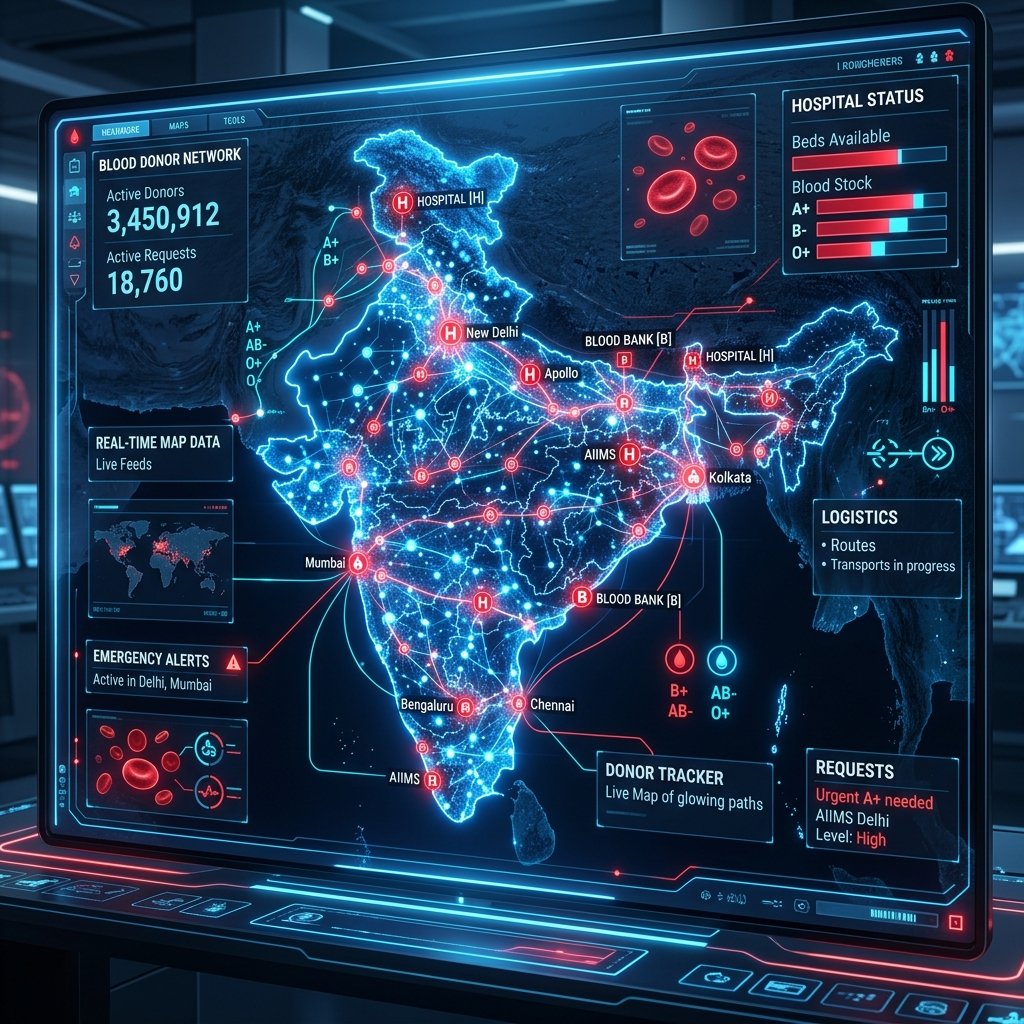
The Evolution of Blood Donation Technology in India
India requires approximately 14.6 million units of blood annually to manage traumatic accident injuries, complex surgeries, cancer therapies, and chronic hematological disorders like Thalassemia Major and Hemophilia. Historically, bridging this deficit relied on static phone directories and disorganized social media forward chains that frequently broadcast expired, fraudulent, or geographically unfeasible requests.
Over the last decade, transfusion medicine in India has witnessed a structural digital transformation. From centralized government repositories to community-driven emergency routing networks like JeevanSeva, technology is systematically eliminating communication friction during life-or-death emergencies.
Centralized Repositories vs. Decentralized Emergency Networks
Understanding the operational architectures of different blood mobilization platforms is critical for hospital social workers, voluntary donors, and patient families:
- Centralized Government Registries (e.g., e-RaktKosh): Overseen by the Ministry of Health and Family Welfare, e-RaktKosh aggregates inventory reports from licensed public and private blood centers. It provides a macroscopic view of cold storage stock availability across states and districts.
- Decentralized Peer-to-Peer Mobilization (e.g., JeevanSeva): Operates as an algorithmic volunteer dispatch network. Rather than merely cataloging static blood bank stock, it matches urgent bed-side hospital requisitions directly to live, pre-verified donors located within a 5-to-10 kilometer transit perimeter.
Comparison Matrix: Blood Mobilization Models in India
| Feature | Centralized Stock Registry (e-RaktKosh) | Decentralized Matching (JeevanSeva) | Unverified Social Media Groups |
|---|---|---|---|
| Core Function | Tracks existing component inventory in banks | Dispatches live voluntary donors to treating hospital | Passive broadcast of emergency telephone numbers |
| Data Freshness | Updated periodically by bank laboratory staff | Real-time geolocation dispatch and live donor status | Uncontrolled forwards; often days or weeks obsolete |
| Donor Verification | Conducted on-site during collection | Pre-screened for eligibility; final test at hospital | Zero verification; high risk of non-responsive contacts |
| Privacy Protection | Institutional access | Encrypted contact masking; zero public number leaks | Severe privacy leaks; phone numbers spammed publicly |
| Commercial Intermediaries | Strictly non-commercial | 100% Free Section 8 Non-Profit guarantee | High vulnerability to paid touts and black-market actors |
Why Voluntary Non-Remunerated Blood Donation (VNRBD) Matters
The World Health Organization (WHO) and India's National Blood Policy strictly endorse 100% Voluntary Non-Remunerated Blood Donation. Commercial paid donation was legally outlawed by the Supreme Court of India in 1996 because financial remuneration incentivizes high-risk individuals to conceal contagious infections or chronic medical conditions. Modern digital platforms must reinforce this legal framework by eliminating monetary transactions and promoting pure altruism.
Future Roadmap: AI and Geo-Fenced Rapid Transit
The next frontier of blood banking in India integrates predictive machine learning models to anticipate seasonal demand surges (such as post-monsoon dengue epidemics) and automatically trigger neighborhood camp drives before inventory reserves dip into critical deficit thresholds.
Frequently Asked Questions
Can private blood banks charge arbitrary fees for blood?
No. Blood in India cannot be bought or sold. Licensed blood banks are strictly permitted to levy only government-regulated processing and testing charges (for NAT/ELISA, grouping, and cross-matching) capped by the National Blood Transfusion Council.
How does JeevanSeva verify that a request is genuine?
Every emergency request submitted on our platform requires proof of an authentic signed hospital requisition slip detailing the treating medical officer's credentials, patient registration number, and hospital admission details.